Loomio: The Digital People's Mic, 25 Years On

The origin story of the Loomio Cooperative is like the opening lines of a joke; two activists walk into a coworking space, and ask, "do you want to develop an app?". But that's exactly how it all began.
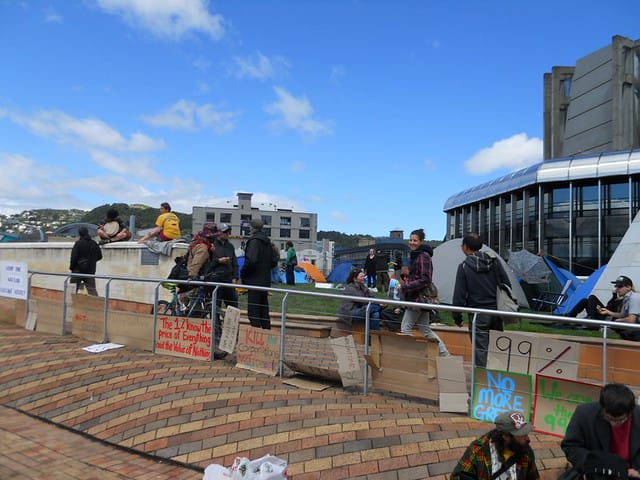
Back in October 2011, Ben Knight and Rich Bartlett - both members of the arts collective Concerned Citizens - joined the Occupy encampment at Civic Square in Te Whanganui-a-Tara. After a few weeks, their minds had been set on fire by the experience of making decisions by consensus at General Assemblies, with huge groups of oddball strangers (including the author, who appears in the photo above). When the occupation camp was evicted in January, they were convinced that its radically participatory democracy could be reproduced as a digital platform.
Following that hunch, Bartlett and Knight dropped into the downtown office space shared by Enspiral - a cluster of social enterprise startups that came together a couple of years before - and asked if any of them could develop a consensus decision-making app. The reply was roughly along the lines of, 'that's something we need here too, how about you develop it with us?'.
 Disintermedia

That's the TED Talk version, so to speak. But as always, there's more to the story.
I set up one of the first three tents that started the Occupy camp in Civic Square. I remember Rich and Ben turning up early on and diving straight into the work, especially in the Communications Working Group. Me being me, I worked hard to get them making more use of community-hosted services, instead of corporate platforms. Still a very fringe concept at the time, even more so than it is now.
But for me it was about walking the talk. We were using the net to build a movement against the rampant financialization that was pumping economic growth hormones into monopolistic corporations, including SillyCon Valley platforms. Occupying those platforms to reach potential supporters was one thing, but doing our core organising in the cradles of surveillance advertising seemed strategically unwise, as well as hypocritical.
My GenX online strategy was a big challenge to the Millennial norms of the Concerned Citizens, but they got the point. After the occupations ended, they kept me in the loop as Loomio was getting started, and even invited me to join the founding team.
I turned down the offer to join the core group - to my lasting regret - because I was still pretty burnt out from months of living in public (I don't recommend it) at occupation camps around the country. Plus I'd just moved cities to start a new relationship with someone I hooked up with at one of them, so I was a bit ... preoccupied. But I did become an active part of the community around the core group, dogfooding the app as they developed it, and contributing ideas on both design and admin issues for about seven years.
Enspiral is now a case study in radically experimental organising, and when Rich and Ben first turned up, many of the crews using the co-working space already had radically democratic aspirations. But it was still structured mostly like a bog standard startup incubator, using off-the-shelf company structures for their social enterprises, and keeping any software they developed proprietary.
So one of the first things I advocated for was a legal structure that made Loomio a worker-owned co-op, and releasing any software they created under a Free Code license. To ensure the Occupy values we arrived at Enspiral with were encoded into both the legal and technical structures of the project.
I was already familiar with the idea of tech co-ops from my time with Indymedia (much of the IMC-tech work was done pro bono by people involved in such co-ops). By the time of Occupy I'd already seen the Dark Side of the startup life cycle, described by Douglas Rushkoff in Throwing Rocks at the Google Bus. I'd been on the pointy end of various rug pulls by corporate platforms, including EGroups - acquired and clumsily merged with Yahoo Groups and eventually deleted - and Ning springing compulsory charges on communities using what had been a freemium service. A democratic company seemed like the best protection, for both the workers building it, and people using their software and service.
Some Enspiral folks were a bit resistant to the co-op company idea at first, because from their POV it was legally risky. But I argued my case and eventually the Loomio crew were sold on it, becoming one of the world's first digital platform co-ops. These discussions took place on a platform called Yammer, since acquired and junked by BorgSoft in yet another rug pull, so sadly I'm not sure there's any record of those discussions.
My second major contribution was on the license front. The first Loomio prototypes had been published under the MIT license. A lax license that makes it legal for corporations to build proprietary products on top of Free Code, without even having to admit it. To prevent this, before too many contributors had departed with their copyrights to make it a clean switch, I pushed for them to switch to a copyleft license, obliging anyone who redistributed their software to publish code for any modifications.
The license I pitched was the same one recommended for server software in the Franklin St Statement, drafted by software freedom activists a few years earlier. The GNU AGPL 3.0 was built on the venerable GNU GPL, adding an obligation to publish modified versions of the code even when the only distribution is running the software on a server. Again, with the full implications clear to the community, AGPL was the winner on the day.
Then came the serious co-design work, shaping what the Loomio experience would become.
About a year before Occupy kicked off I received my Permaculture Design Certificate, after a life-changing residential course with Earthcare Education at Tui Community. Since then I'd been consumed by the challenge of applying permaculture ethics and principles to computers and digital networks (a topic for another blog piece, perhaps).
This is the mindset I brought to early versions of Loomio. I enjoyed bringing new groups to the service, to experiment with online consensus processes, and write up our experiences as feedback to the development team. I spent years regularly testing and giving feedback on early versions of the Loomio interface. Co-creating new features with the vibrant community of early adopters who gathered around it.
Loomio was only one of a plethora of online democracy experiments that came out of the occupation movements, including LiquidFeedback, OpenCollective, and vTaiwan. But Loomio was our one. After the tents had been cleared from the public squares, and the in-person general assemblies ended, this gave us a way to keep working towards our visions of participatory democracy. Sometimes a challenging process, but always rewarding.
This wouldn't be an honest retrospective if I didn't talk about why I don't regularly use Loomio these days, and haven't actively contributed to its development for about a decade. I don't want to give the impression that Loomio went evil, like Goggle. I think it's more that they stayed mostly where they started, focused on building a social enterprise capable of keeping their salaries paid and the lights on. As I continued to surf the bleeding edge of ethical tech innovation, especially in decentralised social networks like the fediverse, the Loomio team's commercial pragmatism chafed more and more against my idealistic neophilia as the years passed.
My disillusionment with Loomio began around 2015. When one of the core developers made a whole series of lame excuses for folding a rogue's gallery of proprietary, DataFarming, corporate-controlled dependencies into both the published code, and the Loomio.org service. In the end the rest of the co-op came around. But the whole incident left me scratching my head.
The disillusion had deepened by 2019, by which time the same developer was regularly and openly rejecting any proposed improvement that didn't have short term dollar signs attached. Then in 2020, communities who had been onboarded under the pay-want-you-can model suddenly started having their Loomio groups crippled. Only to be restored if they started paying a fixed subscription, at a minimum of $1 per group member per year. A move that was disturbingly reminiscent of the Ning rug pull.
The core point I'm making is that the Loomio Cooperative made a mutually beneficial agreement with the groups who joined on a pay-what-you-can plan. Gratis usage for them, testing and feedback (and tolerance of hiccups and bugs) on an in-development service for you. IMHO you have a moral obligation, if not a legal contract, to honour that agreement. Just as you have with groups that joined on a paid plan, under previous pricing regimes.
The co-op eventually relented, but only after demonstrating a passive-aggressive disinterest in designing against lock-in, with the same core developer demonstrating his mercenary streak again and again in the discussion. Some time later, that decisions seems to have been reversed again. Leaving many groups who'd helped co-create Loomio from its earliest versions, and supported its crowdfunding campaigns, with the choice to pay up, use intentionally crippled groups, or walk away.
The breaking point for me came a couple of months after the paywall first went up, when that same mercenary developer channeled his inner Moxie Marlinspike. Replying to a new community member's concerns about the centralised nature of the Loomio.org platform by not only dismissing them out of hand, but utterly rejecting the founding values of the co-op;
It's not that it's harder to monetize, it's much harder and slower to build, and we have decided to provide a user experience driven product for small high trust groups rather than a technologically idealistic approach aimed at solving global politics.
This was too much like the excuses for Ubuntu's Amazon Lens a few years earlier, another project I'd actively supported as a software freedom activist. Once again, it seemed a 'social enterprise' had slipped into a typical for-profit posture, after leveraging the goodwill and unpaid labour of community supporters to build a commercially successful service.
On top of all that, the performance of the Loomio.org platform had been slowly degrading, and the UX remained cludgy and awkward on mobile devices. Which I had become more dependent on at the time, due to unreliable laptops and no money to replace them. With the fediverse developing rapidly after the finalization of ActivityPub, I didn't feel like sticking around to be sneered at, so I moved on from Loomio development.
I've continued to pop in to Loomio.org every now and then, to check in on a few groups still hosted there. The Diaspora Foundation were there at first, but found they weren't using the decision-making tools, and replaced their Loomio group with a Discourse forum in 2017. The P2P Foundation were another group of early adopters, but they finally gave up on their crippled and mostly disused Loomio group earlier this year, and replaced it with Discourse too.
A number of groups I was involved with before and after Occupy experimented with using Loomio, including CreativeCommons Aotearoa/ NZ, the Council of Permaculture in NZ, Pirate Party NZ and the Internet Party, and my first attempt to set up a Free Code hosting co-op. None of these have been active on Loomio.org for years.
The Open App Ecosystem group produced some great knowledge-sharing for a few years. It's been mostly tumbleweeds of late, but it is still on Loomio.org. Social.coop continue to be highly active on their Loomio group. But despite being a casual participant there since it was founded, I was recently booted out for not having filled out the right forms. I don't really mind, like Groucho Marx;
I don’t want to belong to any club that would have me as a member!”
Poking around while drafting this blog post, I see that some of the complaints above have since been addressed. There is a discount for not-for-profit groups, and lifetime community subscriptions have been offered to some volunteer-run groups, including the Open App Ecosystem.
Loomio still has data export available, although it's unclear how difficult it would be to import this into a community-hosted Loomio instance, let alone any other kind of decision-making tool or forum.
People using Loomio still need to forgive the subpar mobile experience, but it looks like a fix for this is in the pipeline, as of earlier this year. There's also the excessive client-side JavaScript that still manages to almost crash not only my web browser but my whole GNU/Linux OS down to the kernel. If I can watch PeerTube videos on my laptop with dozens of windows open, there's no reason a web app made up mostly of text and images ought to put an ounce of stress on my system. A refactor of the Loomio code using something more like Hypermedia-Driven Architecture (HDA) is long overdue.
Federation, however, is still can't fix, won't fix. Clearly the folks currently running the Loomio Co-op haven't been paying attention to what social enterprises like Ghost or the company behind Discourse have been up to. They too publish Free Code for their commercial services, but unlike Loomio, they've embraced ActivityPub as a social web standard for federation between online services.
Loomio is still head and shoulders above using FarceBook Groups, Slick, or Miscord for group communication. No question about it. Even putting aside the AGPL license and the innovation decision-making tools, using a platform governed by its workers, where you're the customer not the product being sold, is a huge step forward.
Loomio today is a far cry from the radically transformative vision of its original Occupy-inspired development community. If that's what you're looking for in 2026, you're probably better to look elsewhere. But if you're a formal entity with a budget, or a volunteer-run group who qualifies for unpaid use, and looking for a reliable online meeting space, you could do much, much worse.