Breaking the Supermarket Monopoly Over Grocery Supplies in Aotearoa

How we can do better than replacing a duopoly with a triopoly
The main purpose of this post is to describe KiwiDelivery, my proposal for a publicly-owned, renewable-powered alternative to the corporate supermarket duopoly. We'll get to that. But first, let's set the scene.
Back in March, I wrote a thread on my Mastodon account responding to Bomber Bradbury's advocacy for a state-backed supermarket chain. A policy he's called for a few times on his weekly podcast The Bradbury Group. Bomber must have been pleased as punch when the Greens announced policy aiming to do exactly that, by forcing the supermarket duopoly to sell a chunk of their operations - retail stores and logistics infrastructure - to a new, publicly-owned supermarket chain; 'KiwiMart'.
With all due respect to Comrade Bradbury and the Greens, this is right up there with 'GST off fruit and veges' as far as uninspiring policy goes. For one thing, it would involve risking huge amounts of public money on a business venture. One that no corporate extractor thinks is viable enough to invest in. This seems ... unwise.
Secondly until we get a woooden stake right into the heart of the corporatist policy vampire ("neoliberalism", "the Washington Consensus"), and kill it dead for good, even success could end in failure. Where after the public purse took all the risk, corporate extractors could still get most of the benefit. Because if KiwiMark worked out, it could be sold off to said extractors by the next NatACT government, on the basis that the state has no place in the supermarket business.
In this case - much as it sticks in my craw - I happen to agree with them. Supplying food can and should be done in a decentralised way, ideally by community-controlled organisations. The supermarket system is already too centralised for my liking, and depending on the state for food security is literally putting all your eggs in one basket.
I agree with what Kieran McAnulty said on the Bradybury Group in March; public provision isn't a silver bullet for everything. I would add; especially when the public service has been been corporatised, restructured and starved of resources for decades. Take a look at KiwiBuild, or the current state of our public health system. Would you want your food supply to depend on a system run like this?
Don't get me wrong, I'm all for revitalising the public service. For public ownership of connecting infrastructure, like the electricity grid, and the road and rail networks. For universal public services in areas like health and education, where commercialisation creates observable perverse incentives. But we can't wish all that into existence overnight. Adding another mission-critical load to an already overwhelmed public service is a recipe for disaster, not food security.
Side note: One thing I learned from looking into the corporatisation of universities is that much of the "wasteful public spending", bemoaned by corporatists like the NatACTs, is a direct product of their reforms. Academic departments used to share resources on an organic, 'who needs it now' basis. When universities were corporatised, each department became a separate 'business unit', and any resources shared with them by other departments are now 'expenses'. So the total on-paper cost of running them goes up, even though no extra resources are being used.
Another example is the cost of flying MPs around the country. When AirNZ was 100% publicly-owned and run as a public good, flying MPs around was just part of its role as the national carrier. If those flights were accounted for at all, they were expenses on the AirNZ balance sheet. But once AirNZ was corporatised, those flights were pushed onto the MPs expense sheets, and counted as public spending. Same flights, same provider, but suddenly a massive costs to the public accounts every year.
But I digress. Coming back to the idea of a state supermarket chain, this is a solution that reflects a lack of deep thinking about the problem. Which is not that we don't have enough owners for our highly centralised, corporate-controlled, grocery supply chains. The problem is that we ended up with these in the first place.
The supermarket chain duopoly is a symptom of that problem, not the cause. For one thing, in a country with robust anti-monopoly enforcement, it never would have come to this. But although anti-monopoly enforcement is definitely required - and incrementally starting to happen thanks to the Grocery Commissioner - that can only open up space for better food supply systems.
So what's my vision for this, if it's not the KiwiBank of supermarkets (KB is also a mostly failed solution to an essential service dominated by an oligopoly of extractive corporations)? Again, no silver bullets here. But I do have a few ideas for how I'd attack the problem as Minister of Groceries.
At the risk of repeating myself, we can't propose radical and effective solutions if we don't have a deep understanding of the problems we're trying to solve. So what is the real guts of our supermarket problem? It's pretty much the same as the social media problem, in a word; centralisation. Resulting in chokepoints where financial vampire taps can be applied to extract wealth from customers (Rebecca Giblin and Cory Doctorow wrote a whole book about exactly this, called Chokepoint Capitalism).
So as with the social web, whatever our solutions are, they need to have the goal of decentralising the system. Moving us away from a handful of grocery supply chains, and towards a diverse network of food supply webs. While still having sufficiently robust food supply institutions, and enough of them, to ensure food security for every community. Purely peer-to-peer food webs have value as proving grounds for new ideas, and ways to temporarily fill gaps, driven by idealism, volunteer work and affinity networks. But by themselves, they're not going to cut it here.
The creation of the a Grocery Commissioner has already taken an important step to move the grocery supply network in this direction. By mandating that wholesalers owned and operated by the duopoly must supply to any retail store on fair terms, rather than giving preferential treatment to stores within their own chain. But this needs robust enforcement, with serious penalties any time they don't do it. Up to and including a forced separation of retail and wholesale operations, as we did in 2001 with Telecom NZ and the fibre-optic network, and a few years before with electricity retail and lines businesses (but sadly not with generation businesses .. yet).
The next step is to ask serious questions about why we drive across town to a warehouse-sized store to get groceries. Instead of getting them from superettes and greengrocers at our local shops, within walking or biking distance. There are a number of reasons, but the main one is that it's cheaper. A lot cheaper. At least on an individual or household basis (although I suspect the total resource cost to the country is much higher).
There's also the catch-22 of local shops not having enough space or turnover to supply specialist items that only certain people buy (eg coconut yoghurt for dairy-free yoghurt lovers like me). But if we could get the prices down in local dairies and superettes, and more people buying food there, that would mostly take care of itself over time. As the logic of competitive markets actually did its work for a change.
So why do local shops charge so much more - sometimes twice as much - for the same goods?
One reason is the aforementioned lack of access to wholesalers at competitive prices. I've known a few people involved in running small dairies over the years, so I know a lot of their stock is bought at retail prices from Pak'nSave. They have to mark it up significantly just to cover the full costs of doing business.
Another reason is that most local shops don't own the building they operate out of. Instead they pay exorbitant commercial rents to yet another bunch of rent-seeking parasites. Who can still profit from untaxed capital gains even if they leave shop buildings sitting empty for years, without the perceived hassles of having tenants. So shop owners have little choice but to pay the asking price, however unreasonable it might get, or go out of business (and many have).
Another reason for high prices in local shops may be lack of effective competition. A knock-on effect of the above, resulting in a lot of dairies, greengrocers, and superettes going bust. Replaced with $2-shop-style stores selling designer landfill, or empty storefronts, or most galling of all, retail outlets for 2 other kinds of economic parasites; real estate companies and tenancy managers.
So what can we do to revitalise local shops, and bring their prices down without bankrupting them?
1) As mentioned above, robust enforcement to prevent wholesalers using price discrimination to allow supermarkets within their own chain to compete unfairly.
2) Educate shopkeepers about their government-backed right to access wholesale goods at fair prices, and how to report any discrimination they experience.
3) Rent stabilisation on commercial lease buildings, when at least 50% of what they sell is food (not junk). Maybe even with an obligation to let them rent-to-own the buildings their shops are in, as individual businesses, or as a body corporate for a block of shops (say, a struggling mall).
4) Ensure access to cheap credit for people wanting to start a business selling at least 50% food, in a residential area. Unlike subsidies, loans are generally paid back. They do come with a fair bit of risk when the borrower is a new business, but this would give the state an instrinsic motivation to make sure the grocery market is as competitive as it can be, so give them the best chances of paying back that startup loan.
There are probably more things we could do to support local shopping options, where people can use active transport instead of cars, and buy fresh food more often. Those I've listed are pretty vague, and need plenty of work on the details. But so does 'start a state-run supermarket chain'. At least the ideas I'm sharing might actually go some way to solving the problem.
So that's revitalising neighbourhood retail. But there's another way we could replace the weekly drive to the stupourmarket, freeing up people's time for other things, and reducing energy use and carbon emissions in the process. That's by making more use of delivery services using cargo bikes or electric vehicles. The need for contactless delivery during lockdowns was the Proof of Concept for this, as are the vege box deliveries set up by CSA (Community Supported Agriculture) schemes.
Grocery and meal delivery is another groups of services that cost far more to use than they actually cost to run. Thanks to various layers of economic rent-seekers - like Uber Eats, and the supermarket dupology's delivery suppliers - who use access to almost bottomless capital to drive most local competitors out of business, and then ramp up prices. Classic enshittification.
Again, we need robust anti-monopoly enforcement to bring some market discipline to these parasites. But again, that only opens up space in the relevant markets. How can we ensure that community-driven delivery businesses - co-ops, social enterprises, CSAs - have the resources they need to step into that space? This is where the money Bomber and the Greens propose to spend on state-run supermarkets could do far more good in pursuit of the same goal; robust competition for the supermarket duopoly.
What I suggest is, rather than set up KiwiMarket, set up KiwiDelivery;
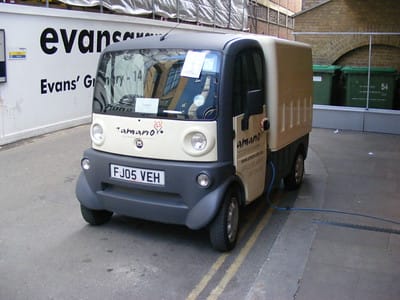
- Buy a fleet of electric vans. Along with charging stations, solar panels and sodium ion battery banks, enough to keep all the vans charged for all day use.
- Hire some local app designers and Open Data people to build Free Code ordering app software, using Open Standards. Workers who will then spend at least some of their earnings in Aotearoa.
- Set up an ordering website using onshore hosting. Protecting the digital sovereignty of the service and the people using it, and helping to grow the local web hosting market.
With all this in place, kiwis could order directly from wholesalers, via KiwiDelivery's trade account, and have their order delivered to their home or workplace at a time convenient to them, with little to no carbon emissions. Completely cutting the duopoly retailers and their price-fixing out the equation. KiwiDelivery could be run as a State-Owned Enterprise, producing a modest return for the public as its shareholder. But it could also be run at cost (including sensible capital retention to cover hard times), as a public good. Like a publicly-owned co-op.
The best part is, whatever the fate of KiwiDelivery as a business venture, it would definitely deliver some lasting benefits. For a start, it would demonstrate that there are alternatives to supplying groceries via giant warehouses we drive a carbon-spewing car across town to get to, once every week or 2, and spend an hour or 2 doing so. Also that there are alternatives to the utter waste of urban space that is a supermarket parking lot. Most of which could eventually be repurposed for intensive housing, given they're right next to a food supply, and usually on public transport routes.
KiwiDelivery would cost a fraction of what it would cost to set up a supermarket chain, and be more likely to work, because using it would be more convenient to use. Even if it didn't, at least it would bring a fleet of late model electric vans into the country, and pile of support infrastructure, which could be repurposed. Instead of leaving behind a bunch of empty buildings and disused parking lots, as failed supermarkets do. I'm not that smart, but even I can see that this would be a much better spend of public money.
The other thing even a failed KiwiDelivery would leave behind is a set of battle-tested delivery ordering software, with all its components designed from the ground up to interoperate in vendor-neutral ways. This Free Code software could be used by anyone wanting to run a grocery ordering portal, provide apps for existing ones, operate a delivery service that delivers for them, and so on. If the KiwiDelivery business failed, the software could continue to be funded as a public good, or development could continue independently, funded by the groups who continue to use it.
In that situation, interest-free public loans could also be made available to not-for-profit groups starting ordering apps or delivery services. All of which would likely result in more competitors for the supermarket chains, and more choices about where and how to buy our gorceries.
A similar service could also be set up for meal delivery, using a fleet of renewably-fueled, publicly-owned vehicles. I can even imagine a model where ordering apps - whether for groceries or meals - are obliged by law to be interoperable with any delivery service. So customers could combine their preferred ordering app with a wide range of food vendors and delivery services, from different companies, instead of being forced to use whichever delivery service is bundled with an app.
In summary, there's definitely juice to be extracted from learning about what's worked in the past, or not, and why. As well as running small-scale, low cost, public service experiments we can study for the same reasons. We need to break the habit of trying to solve problems by treating the superficial symptoms, instead of addressing their causes at the deepest level we can analyze. If we want to solve thorny, structural problems, involving deep inequalities of power and resources, we need to get creative.